SpaceX’s CRS-35 may look like another routine cargo run to the International Space Station, but the mission connects three different phases of orbital operations at once: reusable transportation, continued ISS modernization and research designed for missions beyond low Earth orbit.
SpaceX’s mission plan pairs a Dragon spacecraft flying for the fourth time with a Falcon 9 first stage making its eighth flight. NASA says Dragon is carrying more than 6,300 pounds of science, supplies and station hardware, including the final pair of International Space Station Roll-Out Solar Arrays, or iROSAs.
CRS-35 at a glance
| Mission element | CRS-35 detail |
|---|---|
| Launch vehicle | Falcon 9 |
| Spacecraft | Cargo Dragon |
| Mission | 35th SpaceX Commercial Resupply Services flight for NASA |
| Launch site | SLC-40, Cape Canaveral Space Force Station |
| Dragon flight | 4th |
| Falcon 9 booster flight | 8th |
| Cargo | More than 6,300 lb |
| Destination | International Space Station |
| Planned transit | About 52 hours |
| Docking location | Harmony module, space-facing port |
| Planned station stay | About one month |
SpaceX says this particular Dragon previously supported CRS-26, CRS-29 and CRS-33. The Falcon 9 first stage previously flew KF-01, IMAP, NROL-77, GPS III-9, CRS-34, NROL-95 and a Starlink mission. SpaceX plans to return the booster to Landing Zone 40, rather than recovering it on a droneship.
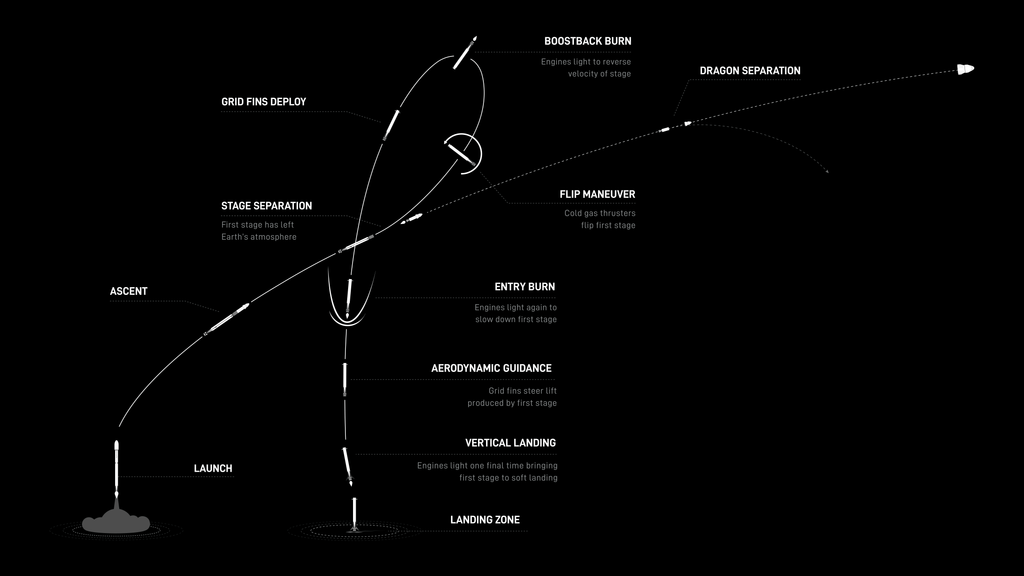
That reuse is only the first part of the mission.
CRS-35 completes a major ISS power upgrade
The most consequential hardware in Dragon’s cargo is the final pair of iROSA solar arrays.
NASA says the pair will complete the augmentation of the station’s electrical-power system, supporting ongoing research and operations as well as the ISS’s eventual safe and controlled deorbit. Astronauts are expected to install the arrays during spacewalks later in the fall.
That gives CRS-35 a role beyond replenishment. It is delivering hardware that changes the station itself during the later stage of its operational life.
The science payload stretches from artificial retinas to brain organoids
The research aboard Dragon is equally varied.
LambdaVision-1 will examine whether microgravity can improve the layer-by-layer manufacturing of artificial retinas. NASA says reduced settling in microgravity may produce more uniform structures, with potential implications for retinal implants on Earth.
Stellar Spheroids uses 3D human heart tissue to study whether microgravity improves the development of vascular networks, potentially supporting better disease models and larger-scale drug testing. MINDS, meanwhile, uses brain organoids assembled from cells from multiple people to investigate neuroinflammation associated with diseases including Alzheimer’s, Parkinson’s and multiple sclerosis.
Another experiment, ELF-Unconventional Glass 2, studies how glass made from non-traditional elements forms without normal gravity-driven effects. NASA says the resulting materials could ultimately offer advantages in strength, optics and durability.
NASA’s Biological and Physical Sciences program is also sending investigations into crop disease, rapid astronaut-health analysis and antibiotic-resistant bacteria, connecting CRS-35 to the broader challenge of keeping crews healthy on longer missions where Earth-based laboratories and resupply are less accessible.
Dragon’s mission continues after docking
SpaceX lays out Dragon’s trip to the station as a sequence rather than a single orbital maneuver.
After Falcon 9 places Dragon into orbit, the spacecraft activates its propulsion, life-support and thermal-control systems. It then performs a series of phasing burns, establishes communication with the ISS, begins relative navigation and finally conducts an autonomous approach and docking. SpaceX expects the journey to take roughly 52 hours.
Dragon’s value also extends to the return trip.
NASA plans to keep the spacecraft docked for roughly a month before bringing it back to Earth in mid-November. Its return cargo is expected to include a failed Canadarm2 joint for engineering analysis, a spacesuit for refurbishment, hardware from the station’s urine processor and a water-filtration unit.
That two-way logistics capability makes CRS-35 more than a delivery run. The same mission is carrying new infrastructure and experiments upward while providing a path for aging hardware and research samples to come back down for analysis.
As the ISS moves deeper into its final years, missions such as CRS-35 increasingly show what commercial resupply has become: not simply cargo transportation, but an operational system linking launch reuse, station maintenance, scientific experimentation and hardware recovery.
The next milestone is Dragon’s autonomous arrival at the station and the installation of the final iROSA pair, completing one of the ISS’s most important late-life infrastructure upgrades.


